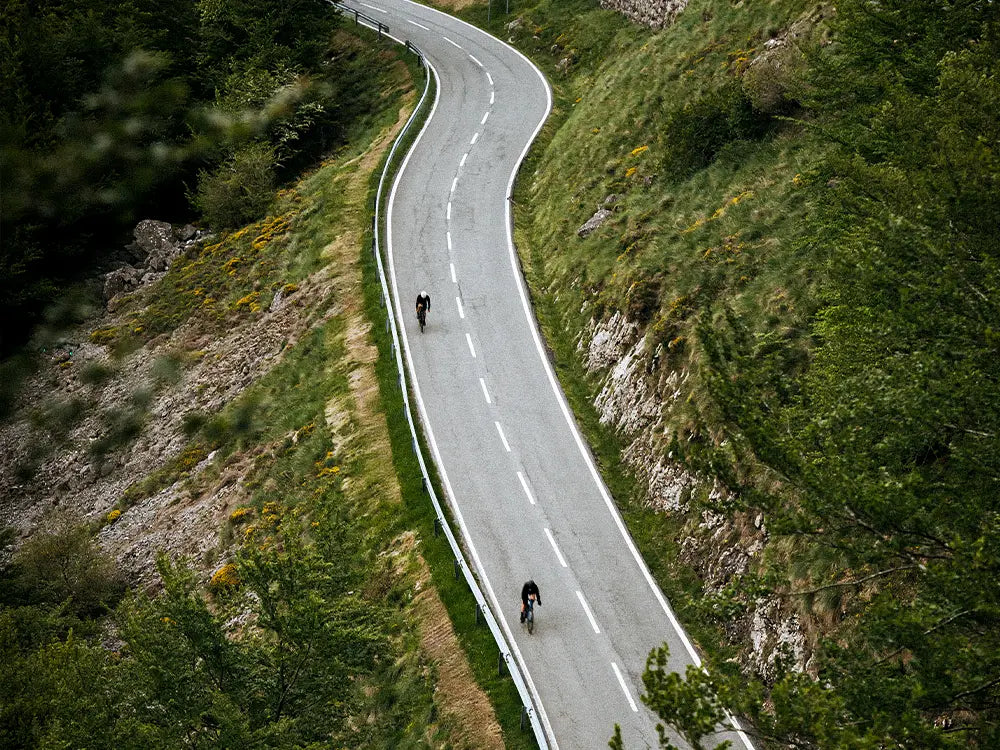


The first time Mike took on the Seorak mountains in South Korea, the experience ended very differently from what he had imagined. He had only been taking cycling seriously for a few months and was used to measuring his progress in times, challenges, and kilometers. But over the years, his way of understanding the sport changed. Three years ago, he became a father and began to see cycling from a different perspective: no personal challenge was more important than returning home safe and sound to his family. From that reflection came the true meaning of Safety First Racing (SFR).
Today, 14 of the group’s 17 members are parents. Although their goals on the bike are different, from those who enjoy gran fondos to those who compete in the MCT’s R League, South Korea’s racing circuit, they all share the same philosophy: enjoying cycling without losing sight of what really matters once they get off the bike.

A team where everyone has a place
In its early days, SFR was just a group of friends with no logo or defined identity, and with the distant idea of competing in the MCT.
Mike drove its growth by inviting cyclists who fit the project, despite the initial reluctance of some members who preferred to keep the circle closed. For him, growing ensured the group’s future and opened the door to those who still did not see themselves as ready to compete, reflecting his own view that cycling goes beyond simple performance.
Today, SFR combines a social side focused on gran fondos with a competitive one in the MCT’s R League. Every cyclist has their place without any requirement to race: being part of the team is not just about being the fastest, but about sharing the journey and improving through mutual support.

A custom that reflects their identity
When the time came to develop a new kit, Mike and Deokja were clear about some of the ideas they wanted to convey, although they still needed to find a way to bring them together visually.
The first starting point was color. The initial proposal leaned toward green, but Heeyeon, the team’s only woman, suggested using a teal shade. The idea won the group over and became the foundation of the design, combined with charcoal gray and white.
With the color palette defined, the next challenge was to bring coherence to the whole. The first attempts were not quite working: the three colors were there, but there was still a missing element capable of connecting them and bringing movement to the composition.
That was when Gobik’s design team proposed incorporating a graphic inspired by moving air, a wave running through the fabric and linking the different tones. The result gave the custom the visual continuity it needed, turning the colors into a shared identity.
“We knew what we wanted to convey, but the wave was not our idea. We would not have gotten there on our own,” explains Deokja, who worked alongside Mike on the development of the kit.
The design ended up becoming a way of representing what happens within the group: different personalities, goals, and ways of experiencing cycling that find common ground.

Today, that kit is much more than fabric and well-combined colors: it is the tangible reflection of a shared way of understanding cycling. The competitive challenges are still there, but now they coexist with what is truly essential: a team, a community, and a shared project where every cyclist contributes. Because wearing the same colors was never just a matter of aesthetics, but of knowing who you share the road home with.


